- Fitness
- Exercise library
- General balance
Balance board exercises
General Balance Board Workouts
Focusing on general balance training is a great place to start. This series of videos includes beginner and advanced variations of each move.
-
BeginnerAdvanced General balance
Single Leg Balance
- One foot centered on the deck.
- Soft knee, eyes on a spot ahead of you.
- Stay as still as you can.
Watch for Locking the knee.
Advanced: add slow arm raises overhead.
-
BeginnerAdvanced General balance
Rocking In Place
- Both feet on the deck, one end ball touching the floor.
- Rock from end ball to end ball and swing your arms like you're jogging.
- Find a steady rhythm. It's a warm-up.
Watch for Stomping the ends down.
Advanced: bend your knees and sink lower as you rock.
-
BeginnerAdvanced General balance
Single Leg RDL
- Stand on one foot in the middle of the deck, soft knee.
- Hinge at the hips with a flat back, free leg reaching behind.
- Squeeze the glute to come back up.
Watch for Bending the standing knee into a squat.
Advanced: finish each rep by pulling the free knee to your chest.
- Full videos
-
 Single Leg RDL – Beginner
-
 Single Leg RDL – Advanced



FAQ
Common questions
What is the best balance board exercise for beginners?
Start with a simple balance hold: both feet centered on the deck, soft knees, eyes on a spot ahead of you. Once you can stay level, move to the single-leg balance, then rocking in place and the single-leg RDL on this page. Each one has a beginner and an advanced video so you can progress at your own pace.
How long should you stand on a balance board each day?
The best amount is the one you'll actually do, so build it into your day instead of adding another workout. Ride the board while you watch a show at night, or step on for a few minutes during movement breaks in your workday. Short sessions spread through the day add up fast, and frequent practice is what makes balance improve.
For a focused workout, start with a few minutes and build toward 10–15 minute sessions as your balance gets better.
How do I get better at balancing on a balance board?
Keep your knees soft, brace your core and look at a fixed point ahead instead of at your feet. Practice often in short bursts, since balance improves with repetition.
Build the strength behind it, too. Add weights: hold dumbbells for squats, lunges and RDLs on the board, and keep up your strength training off it. Eat a high-protein diet so your body has what it needs to build and keep the leg and core muscle that balance depends on.
When a move feels easy, make it harder: one foot instead of two, arms overhead, a slower tempo or a heavier weight.
What muscles does a balance board work?
Balance board training works your ankles, calves, quads, glutes and core all at once, plus the small stabilizing muscles around your joints that floor exercises miss. Moves like the single-leg RDL also hit the hamstrings and glutes hard. It's a full-body balance and stability workout.
Is a balance board good for beginners?
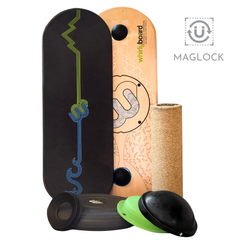
Yes. A balance board is one of the easiest ways to start balance training at home. Start next to a wall, counter or sturdy chair for support. The Whirly Complete is built for this: start on the flat Foundation Deck (level 1) and work up through the SoftStart Cushion and the MagLock3™ ball as you get steadier.