
The Whirly JournalFitness & Movement
The 10-Second Balance Test: What It Means for Longevity and How to Train
What does a 10-second one-leg stance really tell you? Explore the longevity research, try a floor-based check and build a practical balance habit.
5 min read
Eighteen years ago, my mother had a brain aneurysm. We were so lucky that day: she was rushed to the hospital, and they caught it in time. The road to recovery was long. Her balance was terrible, she suffered from vertigo, and we weren't sure she would ever walk again. When things seem bleak and there is no hope in sight, you have to hope anyway.
Until then, I had never thought about how important balance is, not only to how long we live but to how well we live. With persistent training, my mom walked again and returned to her normal life. Today, in her late 70s, she still walks three miles and rides her bike every day. That's why a simple 10-second balance test caught my attention.
Your watch counts steps. Your workout app tracks strength. But when was the last time you checked your balance?
That ability shows up everywhere: stepping over a trail root, changing direction on a court, getting dressed, or moving through a busy kitchen. A few minutes of practice keeps it sharp.
The 10-second balance test offers a simple starting point. Here is what it can tell you, why it became a longevity headline, and how to turn curiosity into practice.
What is the 10-second balance test?
The test checks whether you can maintain a one-leg stance for 10 seconds. Research has linked difficulty completing it with higher mortality during follow-up in adults aged 51–75. It's a quick snapshot, not a crystal ball: the research found a link, not a lifespan prediction. [1]
Why balance became part of the longevity conversation
In a 2022 study published in the British Journal of Sports Medicine, researchers assessed 1,702 adults aged 51–75. About one in five could not complete the test. Over a median seven-year follow-up, inability to complete it was associated with an 84% higher adjusted hazard of death from any cause. [1]
That's a group-level finding, not a personal forecast. The takeaway is simple: train balance alongside strength and cardio.
Try a floor-based balance check
Stand on a level floor next to a counter. (If you've had recent falls or dizziness, check with your doctor first.)
The study's stance used arms at the sides, eyes looking ahead, and the front of the lifted foot resting against the back of the opposite lower leg. Participants had up to three attempts. [2]
For an informal home check:
- Stand beside your support and settle your weight onto one leg.
- Lift the other foot into the position described above, keeping your eyes open.
- Time up to 10 seconds. Put your foot down or use the counter whenever needed.
- Rest, then try the other side if comfortable. Note whether you needed support.

Do the test on the floor, not a board, and use the same spot and shoes each time so you can compare.
Your balance has more than one job
Holding still is only one part of moving well. Researchers distinguish several aspects of balance, which is why one test cannot capture every skill. [3]
- Static balance: staying steady in a position, such as a one-leg stance.
- Dynamic balance: managing your posture while moving, such as walking or turning.
- Anticipatory balance: preparing for a movement, such as shifting your weight before reaching.
- Reactive balance: recovering after an unexpected disturbance, such as a stumble.
Good training hits all four: holding still, moving, reaching and reacting.
Want a fuller picture than one stance? Our free Balance Age test checks four different balance skills in a few minutes.
Build a five-minute balance habit
Five minutes and a counter is all it takes.
Minute 1: Find your center. With both feet on the floor, make small, slow weight shifts from side to side.
Minutes 2–3: Practice one leg at a time. Lift one foot and hold, then switch. Touch the counter only when you need it, and work toward letting go.
Minute 4: Take deliberate steps. Walk slowly sideways along your support, then return. Keep your feet uncrossed.
Minute 5: Repeat your hardest move. Pick the one that challenged you most and do it again.
Supported one-leg stands and controlled sideways walking also appear in the NHS home balance-exercise guidance. [4] When it gets easy, make it harder: let go of the counter, then try it with eyes closed.
Choose an easy reminder: after a walk, before a workout, or during an afternoon break. Consistency beats intensity.
Add a Whirly progression when you are ready
Ready for more? A balance board makes every move harder, and a lot more fun.
Whirly Complete grows with you, from balance zero to balance hero:
- Foundation Deck: the deck on its own for rocking, weight shifts and footwork.
- SoftStart Cushion: take the ball off and set the deck on the cushion for a softer, adjustable challenge.
- Green MagLock3™ Ball: click it on for full 360° tilt and spins.

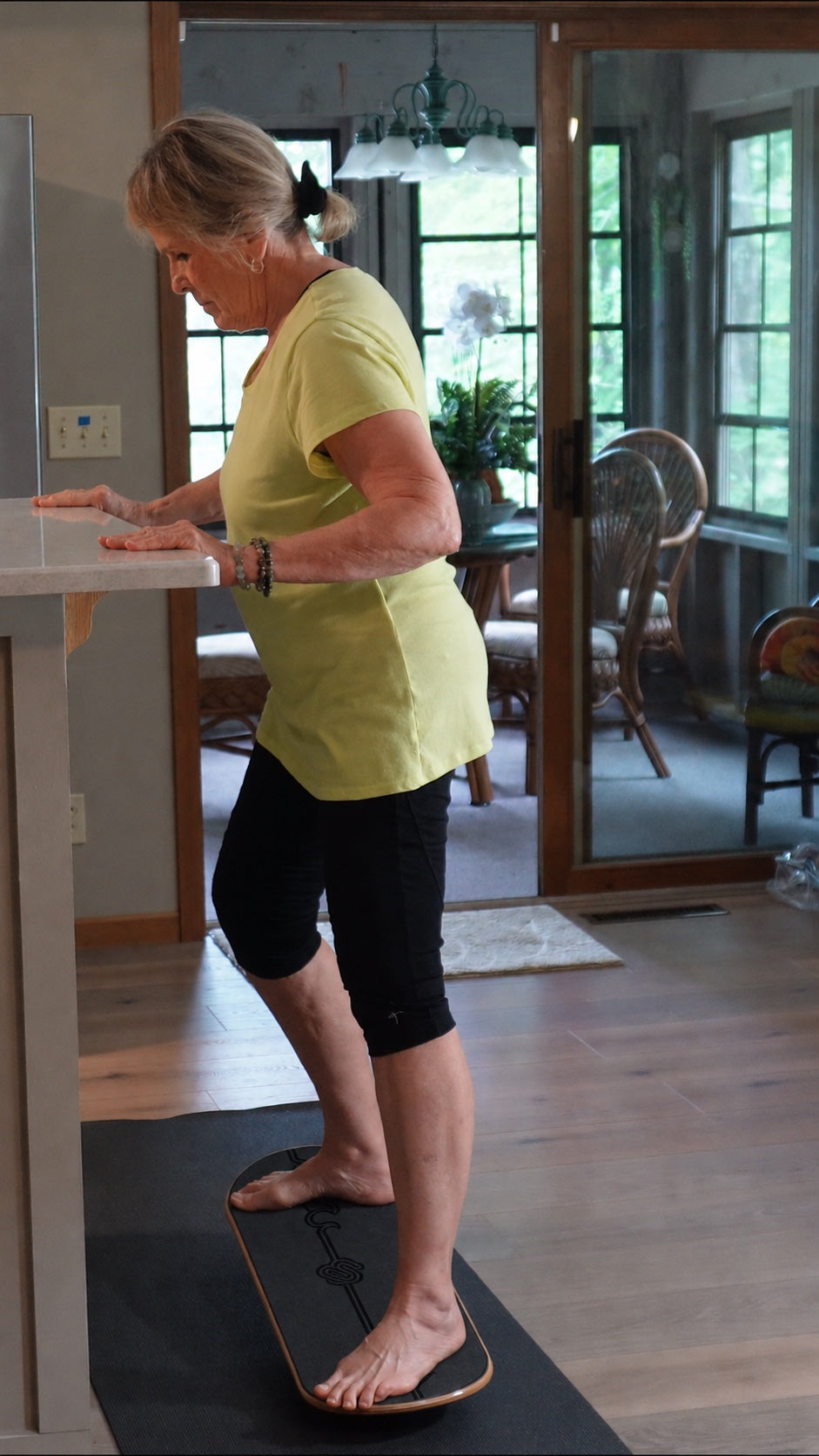
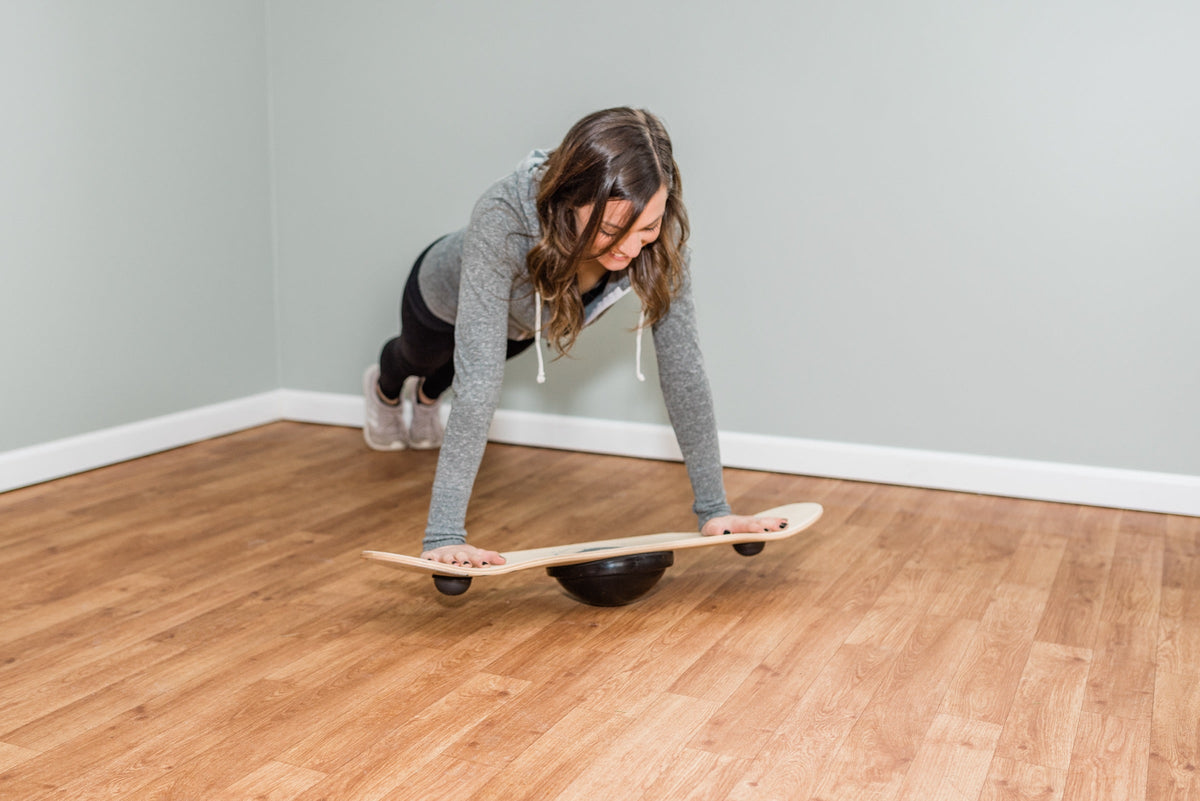
Start with small movements and level up as you go. Once you're steady, add squats, reaches and lunges.
Find more ideas in our balance exercise library. For experienced riders interested in spinning and board-sport practice, Sport 360° is another option.
Build your balance. Find your progression.
Explore Whirly Complete.
What does balance training help with?
Balance training works. A Cochrane review found that balance and functional exercise programs reduced the rate of falls by about 24% in older adults living in the community. [5]
For adults aged 65 and over, WHO recommends varied activity emphasizing functional balance and strength on at least three days a week, alongside aerobic and muscle-strengthening activity. [6]
Think of balance as one part of a well-rounded routine. Keep walking, cycling, swimming, strength training, or whichever activities you enjoy, and give coordination some attention too.
For more on staying active over time, explore Healthy Aging.
Common questions
Can standing on one leg predict my life expectancy?
No single home balance result can tell you your lifespan. The study identified a group-level association. A clinician can interpret balance difficulties alongside your health, mobility and other findings.
Can balance improve after 40?
Yes. Balance responds to regular practice at any adult age. Progress can mean smoother weight shifts, more controlled steps or less reliance on support, not just a longer one-leg hold.
Do I need a board to start?
No. Start on the floor today. Add a board when you want more challenge.
Does passing mean my balance is excellent?
It tells you about that particular task. Walking, turning and responding to a disturbance place different demands on you.
Can a balance board replace strength training or cardio?
No. It's a great partner for strength and cardio, not a replacement.
Start with ten seconds, then keep moving
A short balance check can introduce a useful question: how much attention does coordination get in your week?
Test it today, train it this week, and test again in a month.
Sources
[1] Araújo CG et al. Successful 10-second one-legged stance performance predicts survival in middle-aged and older individuals. British Journal of Sports Medicine, 2022.
[2] BMJ Group. Study announcement and test protocol, June 2022.
[3] Kiss R et al. Associations Between Types of Balance Performance in Healthy Individuals Across the Lifespan: A Systematic Review and Meta-Analysis, 2018.
[4] NHS. Balance exercises.
[5] Sherrington C et al. Exercise for preventing falls in older people living in the community. Cochrane, 2019.
[6] WHO. Guidelines on physical activity and sedentary behaviour: recommendations, 2020.