
The Whirly JournalFitness & Movement
Perimenopause and Balance: Why I Keep Training for What Comes Next
Joanna’s personal take on perimenopause and balance, the research on training in midlife, and practical ways to build a progressive balance habit.
By Joanna Mortensen7 min read
I ran into a friend at my local coffee shop who I hadn’t seen in a while, and we fell into the usual “how have you been?” conversation. She started telling me about her messed-up shin and twisted ankle from running up the stairs to deliver a lecture on something way over my head at a conference. She said her balance wasn’t like it used to be—that perimenopause has changed her.
And she was right. Women our age are shouting from the rooftops to be heard, and we’re often ignored. We spend half of our lives dealing with fluctuating hormones and the roller coaster of monthly cycles, only to finally start figuring ourselves and our bodies out—just to be thrown into this unexpected changing event, navigating the rapids alone.
Talking about menopause makes us feel old, so we like to pretend it isn’t happening—even though we’re constantly pulling at our cheeks and jawline, trying to remember what it was like before double chins and sagging jowls. (No? Just me?)
I honestly look in the mirror and I’m surprised by the person looking back at me, as if an imposter has invaded my body.
Okay—I’m being a little dramatic. But I know I’m on the edge of everything about to change for me. I’m leaving my once-fertile, youthful self behind and stepping into the confident, “I don’t give a damn” woman I’m meant to become.
The thing is, no one tells you that beyond the physical changes—the hot flashes, the unpredictable cycles, the skin that doesn’t bounce back—there’s a silent thief coming for something much more deeply seeded in our day-to-day lives than just our vanity: our balance.
Can perimenopause affect balance?
Researchers are investigating how hormones interact with the systems that keep us steady. Estrogen receptors are present in parts of the vestibular system, the inner-ear and brain networks involved in balance and spatial orientation. A review of the hormone–vestibular literature describes a plausible connection, while also highlighting gaps in clinical evidence. [1]
That gives us a reason to take women’s experiences seriously. It doesn’t tell us what caused my friend’s injury, or mean every woman will develop balance problems during perimenopause. Feeling less steady deserves attention, rather than an automatic “that’s just getting older.”
Put simply: Your balance system is like a team: your eyes spot what is around you, your inner ears help sense movement, and your muscles help you adjust. Researchers are studying how hormone changes may affect that teamwork.
The hidden sense behind stability: proprioception
Proprioception is your body’s sense of position and movement. It helps you know where your foot is landing or how far your knee is bent without watching every adjustment. Balance also draws on vision, the vestibular system, strength and coordination. There is a lot happening behind something as ordinary as stepping over a root on a trail.
Think of it this way: Proprioception is your body’s built-in GPS. It helps your brain keep track of your feet and legs without you having to look down at them.
I hear this from friends and customers: “I just don’t feel as stable as I used to.” “I’m nervous on stairs now.” “I wobble when I put on my shoes standing up.”
Those are useful changes to notice. They give you something practical to work on and, when needed, discuss with a clinician. They don’t mean you have missed your chance to improve.


What does the research say about training in midlife?
Here is the encouraging part. A randomized controlled trial enrolled 50 sedentary women aged 40–60. The training group attended a physiotherapist-designed balance-strategy program twice a week for 12 weeks. Compared with the control group, they improved measured balance, ankle flexibility and strength in several leg muscles. Benefits were maintained at the nine-month follow-up. [2]
This study tested a structured exercise program, not Whirly Board. It gives us useful evidence that women in midlife can improve balance through practice. It also makes balance worth including alongside the strength training and cardio we already hear so much about.
What that means: The women practiced balance regularly and got better at it. They still showed those gains months later. Balance is a skill you can work on, even in midlife.
Why I keep coming back to my board
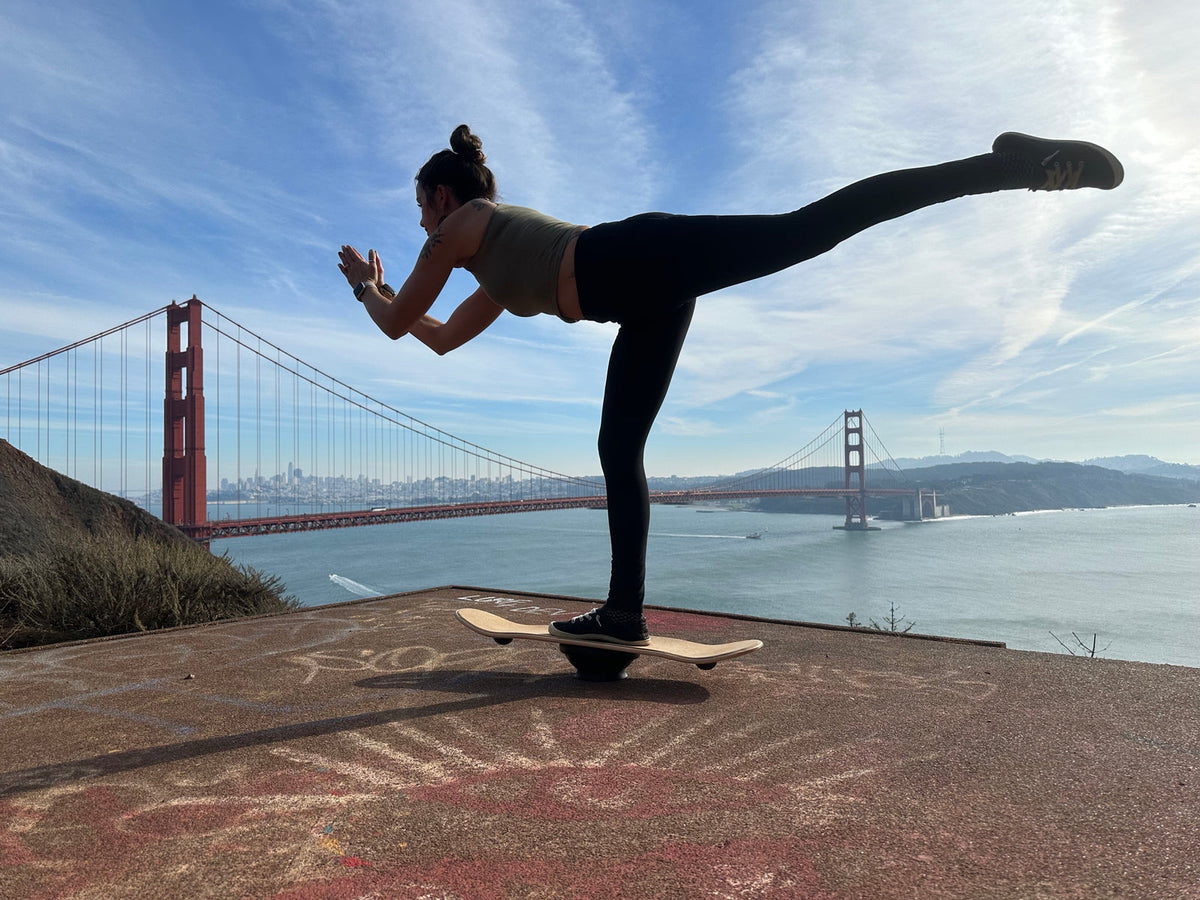
I can still hop on a balance board and stand on one leg while performing the warrior III pose without falling flat on my face. I can navigate icy Wisconsin winter parking lots without that creeping uncertainty in my step. And when I bend down to grab something, I don’t need to steady myself on the nearest piece of furniture, unless I’m suffering from a wine headache, but that’s self-inflicted.
I’m not exceptional. I don’t have superior genetics or a background as a professional athlete. What I do have is a decade of consistent, low-intensity balance training—usually just five to ten minutes a day, often while I’m working at my standing desk or watching TV.
My husband Erik invented a balance board in our garage, and I became the unofficial test pilot. What started as supporting his vision turned into a daily habit that I now realize was one of the best investments I’ve ever made in my future self.
Balance practice as retirement savings for your body
Researchers use the term motor reserve to explore why people differ in their ability to maintain movement function as they age or face neurological challenges. It is an evolving research framework, with questions still open about how best to measure and build it. [3]
In everyday terms: Motor reserve is the idea of having some extra movement ability to draw on when things get harder, a little like having extra battery charge. Scientists are still figuring out how that reserve works and how to measure it.
I think of my own practice like retirement savings for my body. I want to keep investing in the movements I enjoy: hiking, riding, changing direction, getting down on the floor and back up again. The habit gives those skills a place in my day.
I can’t tell you how perimenopause would have felt without that habit. What I can tell you is that balance training has remained part of how I move, and I want to keep it there.
Start where you are, then give yourself somewhere to go
Here’s the thing that breaks my heart: I talk to women who want to improve their balance but feel like they can’t even start. An unfamiliar board can feel like a big leap when you’re already unsure of your footing.
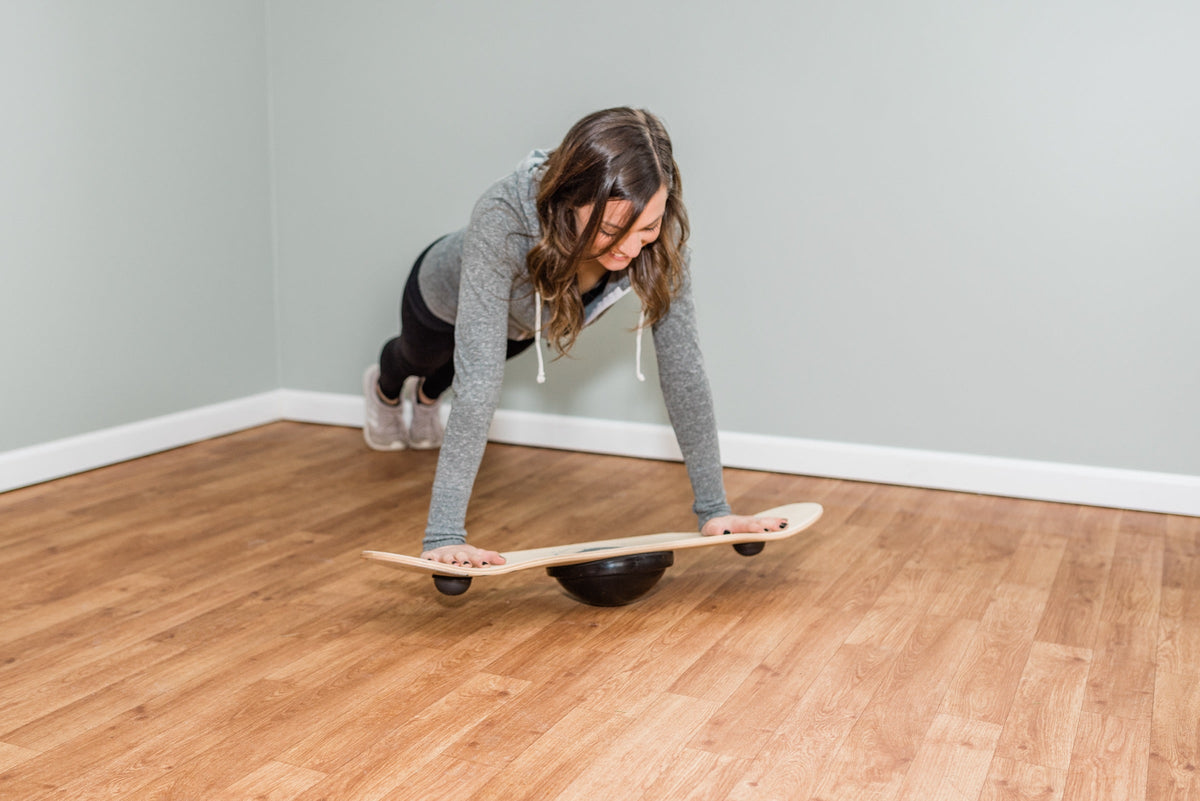
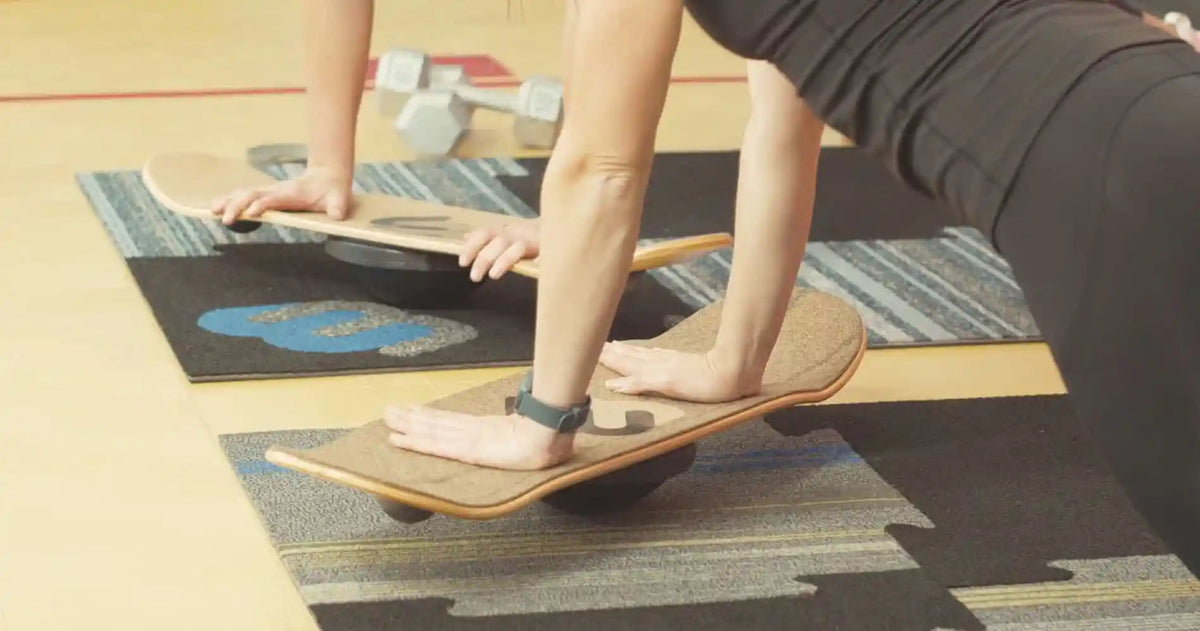
That is where a progression helps. Whirly Complete gives you different ways to use the same deck, so you can choose a challenge that fits your current ability and keep changing it as you improve.
- Foundation Deck: use the deck on its own to explore rocking, controlled weight shifts and footwork.
- SoftStart Cushion: remove the ball and place the deck on the cushion for an adjustable setup.
- Green MagLock3™ Ball: attach the green ball for 360° movement and a new balance challenge.
- Black ball and cork roller: the Full Progression package adds further ways to challenge your control as your skills develop.

Once you are comfortable with your setup, you can build variety through small weight shifts, controlled reaches and shallow squats. Make the movement more deliberate before making it more difficult. Our exercise library gives you more ideas to work toward.
Make it a habit that fits your actual life
My own practice is usually five to ten minutes at a time, often at my standing desk or while watching TV. That is my routine, not a research-proven prescription for perimenopause.
A useful place to begin is a small, repeatable session:
- Choose your moment. Before your workout, between meetings or during an evening TV break.
- Choose one skill. Try controlled rocking, weight shifts or a steady stance on the setup you know.
- Notice one change. Is the movement smoother? Are you making smaller corrections? Does that setup feel more familiar?
- Build variety over time. Add a reach, change direction or try the next setup when you are ready.
Keep walking, cycling, lifting or doing the activities you already love. Give balance a regular place beside them. If you want guidance, see our live classes for current options and availability.
Common questions about perimenopause and balance
Can perimenopause make you feel less steady?
Some women notice changes in steadiness during this stage, and research is exploring hormone–vestibular relationships. A change in balance can have several causes, so it is worth looking beyond hormones alone. [1]
Can balance improve in your forties or fifties?
Yes. The trial in women aged 40–60 found improvements after a 12-week balance-strategy program, with benefits maintained at follow-up. Progress can include better control and coordination as well as improved test results. [2]
Is dizziness the same as losing balance?
Dizziness can include feeling light-headed or unsteady; vertigo is a sensation of movement or spinning. Difficulty maintaining balance is a related but different experience. New or persistent symptoms deserve individual assessment.
Do you need to be good at balance to use Complete?
You can choose a starting setup and progress over time. The Beginner package includes the Foundation Deck, SoftStart Cushion and green MagLock3™ Ball. The Full Progression package adds the black ball and cork roller, giving you more options as your control develops.
Your future self is worth the practice
I think about this a lot: if I hadn’t spent the last decade building my balance capability, would this stage have felt different? I’ll never know for sure. But I’m grateful the habit is already part of my life.
You don’t have to wait until you feel less steady to start paying attention to balance. Find a starting point you enjoy and give yourself room to progress.
Explore Whirly Complete, find a live class, or read more about staying active as you age.
This article shares personal experience and general education. If you have new or persistent dizziness or balance changes, discuss them with a healthcare professional before starting a new exercise plan.
Sources
- Vestibular Disorders and Hormonal Dysregulations: State of the Art and Clinical Perspectives, 2023.
- Fu S, Low Choy N, Nitz J. Controlling balance decline across the menopause using a balance-strategy training program: a randomized, controlled trial. Climacteric, 2009.
- Zeller D et al. Considering the response in addition to the challenge: a narrative review in appraisal of a motor reserve framework. Aging, 2024.